The Economist 2027: 50 clues, an unsettled World, and our test
By. Sajida Farheen farhee
Every year at the close of the calendar, the release of The Economist’s special edition, The World Ahead, sparks a familiar wave of speculation around the world. Some treat it as a collection of cryptic hints, while others dismiss it as mere journalistic cleverness. In reality, however, the issue sketches out the major pressures, rivalries, and trends for the coming year—forces whose roots have already begun sinking into the ground. Looking at the covers of 2024, 2025, 2026, and now 2027 side by side reveals more than just a handful of illustrations; it tells the story of a shifting global mood.
2024 to 2026: How Much Truth, How Much Guesswork?
Reviewing the past three years shows that a substantial share of the central themes featured on these covers—roughly sixty to seventy percent—tends to surface in one form or another over the following twelve months. The transparent ballot box placed at the center of the 2024 cover signaled that voter power and political choices would reshape landscapes across the globe, and that year indeed went down as one of the largest electoral cycles in history. On the grid-divided cover of 2025, symbols surrounding Donald Trump—trade friction, tariffs, energy, and a shifting global balance—stood out prominently, and economic and commercial volatility throughout the year revolved around those very points. The 2026 cover brought heightened geopolitical strain, maritime and land friction, and economic pressure into sharper focus. Still, like every year, these covers do not capture sudden “black swan” shocks that no one could have anticipated in advance.
The 2027 Cover: Unease Wrapped in Red and Black
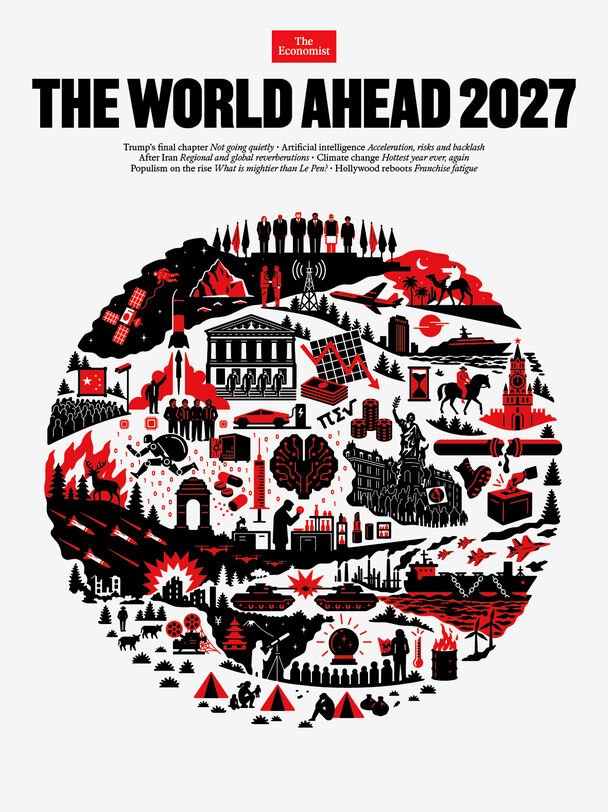
Now that the 2027 cover is out, its tone feels sharper and more unsettled than before. Across a white background, a circular globe rendered in black and red is packed with dozens of symbols, and the headlines above make it clear that the year ahead will not be easy. It frames the closing chapter of Trump’s presidency as anything but a quiet exit; highlights rapid advances in artificial intelligence alongside its risks and public and legal pushback; points to regional and global repercussions in the aftermath of Iran; brings rising heat and climate extremes back to the forefront; questions the growing pull of populist politics in Europe and elsewhere; and even notes fatigue with aging Hollywood franchises and reboots.
Reading the cover’s imagery from top to bottom brings the picture into sharper relief. World leaders and centers of power standing near the top suggest that major decisions are concentrating in fewer hands while ordinary people are left to absorb the consequences. Toward the middle, geopolitical friction, maritime and land clashes, missiles, tanks, and fighter jets point to rising military anxiety, while a broken pipeline, oil engulfed in flames, chained vessels, and falling economic charts signal supply-chain disruptions, inflation, and financial instability. On the other side, artificial intelligence, robotics, digital surveillance, the space race, biotechnology experiments, and the push toward electric vehicles indicate that new technological and energy models are remaking older structures. At the very bottom, displaced people, families outside camps, and fleeing wildlife underscore a harsh truth: the heaviest cost of global turmoil falls on the vulnerable and everyday citizens.
Beyond Human Estimates: Revelation and Divine Measure
The Economist and other institutions may get their forecasts right or wrong, as human knowledge is limited and the unseen belongs to Allah alone. The Quran reminds us that corruption on land and sea results from human actions (Surah Ar-Rum: 41), while warning against usury, exploitation, and injustice (Al-Baqarah: 279).
Similarly, its warning against altering Allah’s creation (An-Nisa: 119) raises important moral questions about human intervention in nature. Whether we consider environmental upheavals, economic crises, or predictions of future turmoil, the lesson is clear: charts and forecasts cannot explain the deeper moral and spiritual realities. Such warnings should inspire awareness and self-reform, not rigid predictions tied to specific dates or years.
Fifty Clues on the 2027 Cover: Layers of the Visual Map
Looking closely at the visual layout beyond these moral and spiritual reflections, the cover reads like a compact map of fifty distinct cues, each holding a possible thread of next year’s story. Grouping all fifty symbols by theme helps bring the broader picture of global politics, economics, technology, environment, and society into clearer focus.
Global Leadership, Power Centers, and the Middle East: Near the top, a row of leaders and a gathering of leaders reflect political authority, great-power decision-making, and alliances, while national flags point to geopolitical rivalry. The Statue of Liberty signals American global influence, the Kremlin Tower points to Russian power, and the Chinese flag alongside a pagoda highlights the economic and cultural rise of Asia, particularly China. Elsewhere, a crescent and star evoke the Muslim world’s influence, while a camel and palm trees underscore the Middle East, oil, and regional stakes. Amid them, mountains suggest geographical barriers and border disputes, while a luxury yacht symbolizes global elites and concentrated wealth.
Economic Volatility, Trade, and Urban Life: On the economic front, a downward graph warns of market instability and slowdown, accompanied by bundles of cash pointing to debt and capital flows, and coins or tokens reflecting financial speculation. A classical building—suggesting a bank or government institution—tests regulatory and institutional stability, while modern towers reflect rapid urbanization and the growing weight of major cities in the global economy. In energy and mobility, a car and a charging point signal the shift toward electric vehicles and cleaner power, while an airplane represents global travel and trade.
Military Tension, Conflict, and Security Risks: A sizable portion of the cover reflects martial unease, with two tanks—on the left and right—pointing to regional conflicts and rising defense spending. Fighter jets signal aerial posturing, missiles suggest arms competition, and a military boot reflects growing militarization. At sea, a chained ship points to supply-chain bottlenecks and blockade risks, while a broken pipe signals threats to energy infrastructure or supply lines, and blasts alongside damaged buildings convey urban destruction and insecurity.
Technology, the Space Race, and Medicine: In technology and science, a circuit-patterned brain representing AI, computers or servers, and an industrial robot or mechanical arm point to digitalization, data-driven economies, and changing work through automation. A telecommunications antenna speaks to connectivity and information control, while a satellite, a rocket, and an astronomer with a telescope evoke space competition, surveillance, and the pursuit of new scientific frontiers. Similarly, a researcher in a laboratory, test tubes, and a syringe highlight biotechnology, pharmaceuticals, and rapid medical experimentation.
Ecological Strain, Society, and Future Uncertainty: On the environmental side, a thermometer points to rising temperatures and global warming, a barrel surrounded by flames signals fossil-fuel strain, and a forest and deer amid flames—alongside forest wildlife—evoke climate disruption and biodiversity loss. Socially and politically, a ballot box reflects elections and democratic fragility, crowds and a crowd gathered before a building point to public pressure and protest, and people arranged in a semicircle suggest collective public opinion. A horseman hints at the return of tradition and nationalism, an arch or monument reflects cultural heritage, and a film camera points to the soft power of entertainment. Finally, an hourglass underscores the delicacy of time and narrow windows of opportunity, while a star-studded crystal ball stands for future uncertainty and alternative scenarios.
A Message for Pakistan and Conclusion
Taken together, these symbols, trends, and signals bring us back to a central point: the world is no longer simple or easily predictable. Whenever global energy markets, trade, Middle Eastern dynamics, or great-power rivalries intensify, the repercussions for a country like Pakistan are never distant news. Fluctuations in oil and energy markets, sensitivity around exports and trade routes, and acute climate stress affect our economy and daily life directly. Alongside that, rather than remaining passive spectators to artificial intelligence and emerging technologies, guiding our human talent, economic self-reliance, and regulatory frameworks in the right direction has become essential.
The Economist’s covers are neither scripture nor sealed destiny, yet ignoring them is unwise either. The experience of 2024 through 2026 shows that these illustrations often point toward winds that have already started blowing. The 2027 cover likewise suggests that the world is entering a harsher, more unpredictable phase—and our real test is whether we stop at commentary or steady our own ship with faith, fairness, and timely preparation
About the Author
Sajida Farheen is a Gold Medalist and currently serving as Director (HR-IT-Media), the author previously worked as a Senior Analyst and has contributed to leading Pakistani publications. She is also a freelance journalist, columnist, poet and digital content creator.
Disclaimer: The views expressed in this article are those of the author and do not necessarily reflect the views or editorial position of Daily Global South